

📋 Everything In This Guide
Why Jaisalmer Is Unlike Anywhere Else in India
There are Indian cities with older forts. There are cities with more monuments, more museums, more listed heritage sites. But there is no other city in India — possibly in the world — where 800 years of living history, an active desert ecosystem, a medieval fort with 3,000 residents and one of the great camel-safari landscapes on earth come together in a radius of 50 kilometres. Jaisalmer is the westernmost major city in India. The Pakistan border is 100 kilometres away. The Thar Desert begins the moment you step outside the city walls and doesn’t stop for hundreds of kilometres. This is not background — it is the entire point of the city.
Jaisalmer was founded in 1156 CE by Rawal Jaisal, a Bhati Rajput chief, on a triangular rocky ridge 76 metres above the surrounding plains. He chose the site partly for its defensive advantages — a fort on a rock is harder to siege — and partly because it sat on the Silk Route trading road that connected Delhi, Sindh (now Pakistan) and Central Asia. For 600 years, Jaisalmer grew rich on trade tolls and remained one of the most strategically significant cities in western India, its merchants building havelis of such intricacy and craftsmanship that they still stop people in their tracks today.
The city nearly died in the 20th century. The opening of the Suez Canal and the development of port-based sea trade killed the overland Silk Route. Partition in 1947 closed the border with Pakistan permanently and cut off the last remnants of the old trade network. For decades, Jaisalmer was a forgotten outpost — a military posting town on the edge of the desert with a magnificent fort that nobody visited. Tourism came slowly, beginning in the 1980s, and the city’s remoteness — which had been its misfortune — became its greatest advantage. Jaisalmer never got developed into irrelevance. It survived its near-extinction with its architecture and its desert culture almost entirely intact.
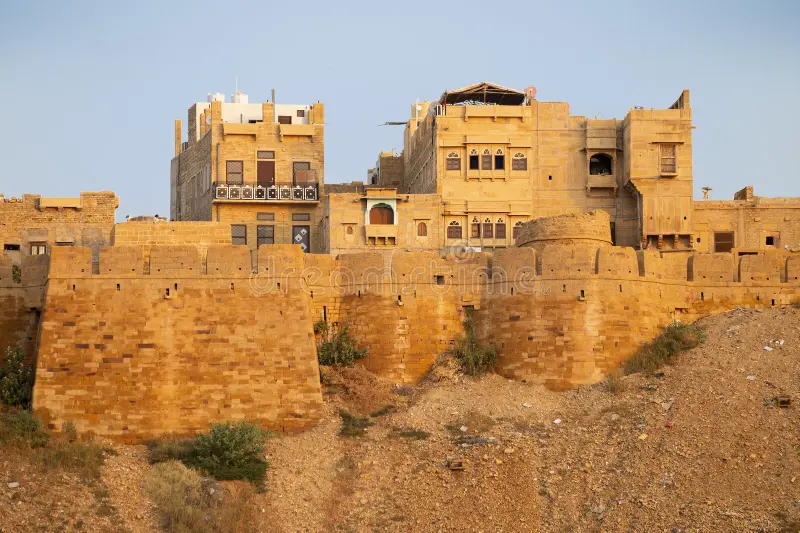
Sonar Quila — The Living Golden Fort
The first thing to understand about Jaisalmer Fort is that it is not a monument. It is a neighbourhood. A fully inhabited, functioning medieval neighbourhood that also happens to sit inside 800-year-old sandstone walls rising 76 metres above the desert. Approximately 3,000 to 4,000 people live inside the fort — temples, guesthouses, restaurants, schools, government offices, a post office, sweet shops, a jewellery bazaar, and vegetable markets all operate within the same walls that have been standing since the 12th century. This is what makes Jaisalmer Fort categorically different from any other fort in India, and why it’s listed among the UNESCO World Heritage Sites as part of the Hill Forts of Rajasthan.
The fort is built from yellow Jurassic sandstone — the same stone that forms the desert cliffs and ridges around the city — and this is why it appears to glow at sunrise and sunset, when the low-angle light turns the entire structure from yellow to deep gold to amber. The colour changes continuously throughout the day. At noon in summer it’s pale yellow, almost bleached. In the late afternoon it deepens to a warm honey. At sunset on a clear day it turns the colour of fire. Dawn — which most tourists miss because they’re at the Sam Sand Dunes the night before — is arguably the finest light: a cool, clear gold against a deep blue sky, before the day’s haze builds.
🏰 Fort Fast Facts — Things Most Guides Don’t Tell You
- 🗓 Founded: 1156 CE by Rawal Jaisal — making it nearly 870 years old and still inhabited
- 📐 Dimensions: 1.5 km perimeter wall | 99 bastions (towers) — 92 of which are still intact
- 🏠 Living Population: Approximately 3,000–4,000 residents live inside the walls year-round
- 🌊 The Drainage Crisis: The fort is slowly being damaged by modern water use — residents use far more water than the medieval drainage system was designed to handle, and the excess is undermining the sandstone foundations. Conservation is ongoing but the structural risk is real
- 🎬 Cinema History: Satyajit Ray set his Feluda detective novella “Sonar Kella” (The Golden Fortress) here. The 1974 film adaptation brought the first major wave of Bengali tourists to Jaisalmer — many locals still call the fort “Sonar Kella”
- 🛡 Sieges Survived: The fort withstood at least three major sieges — by Alauddin Khilji (1299), by Feroz Shah Tughlaq (1360s), and multiple Mughal incursions — and was never permanently taken by an enemy

🏛 Fort Palace Museum (Raj Mahal) — Inside the Royal Chambers
The Fort Palace — known locally as the Raj Mahal — occupies the highest point within the fort complex and was the residential palace of the Jaisalmer rulers from the medieval period through to the 20th century. The museum inside is more intimate and personal than the vast fort museums of Jodhpur or Jaipur — because the palace itself is relatively compact, the objects displayed feel closer, more human-scale. The collection includes royal costumes with mirror-work embroidery of extraordinary quality, photographs of the last ruling Maharajas in the British colonial period, weapons and armour, the original Durbar Hall where the Maharawal received subjects, and a rooftop terrace from which the view over the entire fort and the desert beyond is the best available from inside the walls.
The carved jali (lattice) stonework in the palace windows is particularly fine — five-storey carved stone screens that catch the desert light and cast geometric shadow patterns across the floors. This is the same tradition as the jali work in Mughal monuments, but done in the yellower, grainier Jaisalmer sandstone rather than the whiter Makrana marble, which gives it a rougher, more elemental quality. The artisans who carved these screens over multiple generations were working from a tradition that no longer exists in its original form — each screen is effectively irreplaceable.
Allow 1.5 to 2 hours for the museum. The audio guide is available in multiple languages and significantly improves the experience — several of the exhibits make little sense without context that the audio provides. Combine the museum visit with a walk through the fort’s residential lanes immediately before or after — the contrast between the museum’s curated royal history and the lived-in, washing-on-the-line reality of the inhabited fort is one of Jaisalmer’s most interesting paradoxes.
How to Get to Jaisalmer
Routes to Jaisalmer
- 🚂 By Train — The Recommended Option: The overnight train from Delhi (Jaisalmer Express, Hazrat Nizamuddin to Jaisalmer, 14–15 hours) is the standard approach for most travellers doing the Rajasthan circuit. It arrives in Jaisalmer in the morning, giving you a full first day. From Jodhpur, the daily Jodhpur–Jaisalmer Express takes 5–6 hours and passes through some spectacular desert landscape — worth doing in daylight if schedules permit. From Jaipur to Jaisalmer, the Shatabdi–Jaisalmer route via Jodhpur runs 12–13 hours. Book on IRCTC at least 10–14 days ahead in peak season (October–February) — this route fills up entirely. Sleeper class (₹300–500) gets you there fine; 3AC (₹700–1,100) is considerably more comfortable for the overnight journey.
- 🚗 By Road — Desert Highway NH125: The Jodhpur–Jaisalmer road (NH125) is one of the most scenically dramatic highways in Rajasthan — flat desert all the way, occasional wind turbine farms, the landscape getting progressively more arid and sand-coloured for 291 km. Private cab from Jodhpur costs ₹2,800–4,500 one-way. The RSRTC Volvo bus (Jodhpur–Jaisalmer, 5–6 hours, ₹350–500) is a reasonable option if you book in advance. Shared cabs exist but timings are irregular. From Bikaner, the route runs 330 km (5 hours) via Pokhran — an interesting alternative approach through the Thar that most travellers never see.
- ✈️ By Air — Limited Connectivity: Jaisalmer Airport (JSA) is a dual-use civil-military airport that operates limited commercial flights. IndiGo and Air India run seasonal services from Delhi (1.5 hours) and Jaipur (45 minutes). Check current schedules — flights are added and removed based on seasonal demand and military requirements. The airport is 15 minutes from the city; cab costs ₹150–250. Flying in and taking the train back (or vice versa) is an efficient way to handle the long distances involved in the Rajasthan circuit.
- 🏍 By Motorcycle — For the Adventurous: The Jodhpur–Jaisalmer highway on a motorcycle is one of the classic Indian riding routes — relatively light traffic after Phalodi, wide road, dramatic desert scenery. Royal Enfield rental available in Jodhpur (₹800–1,500/day). The journey takes 5–6 hours at a relaxed pace with stops. Not recommended in summer (April–June) when road surface temperatures can exceed 60°C.
Best Time to Visit Jaisalmer
Month-by-Month — The Desert Calendar
- 🌟 February — Desert Festival Month: The Jaisalmer Desert Festival (dates vary by year based on the full moon) is one of India’s most spectacular cultural events — three days of camel racing, folk music, turban-tying competitions, camel polo and the famous Mr. Desert contest held against the backdrop of the Sam Sand Dunes and Jaisalmer Fort. Temperature 8°C–24°C. This is the single best reason to time your visit precisely. Accommodation books out 3–4 weeks in advance; plan accordingly.
- ✨ October–November — The Secret Best Window: Post-monsoon air quality is excellent — the desert that has been lightly washed is cleaner, sharper, and the sky is a deeper blue than in winter. Temperatures are 14°C–30°C (daytime comfortable, nights pleasant). Fewer tourists than peak winter season. Diwali in the desert — the fort lit with oil lamps and fireworks visible for kilometres across the flat landscape — is a genuinely extraordinary experience that most Jaisalmer guides never mention.
- ❄️ December–January — Peak Season: Maximum tourist footfall and maximum prices — but the reason is valid. Daytime at 16°C–22°C is perfect for fort exploration and dune walks. Nights can drop to 4–6°C, which makes the bonfire and folk music culture at the Sam Sand Dune camps especially atmospheric. Book hotels and dune camps 3–4 weeks ahead. The cool, clear air gives long-distance visibility from the fort ramparts that doesn’t happen in spring.
- 🌸 March: Warming rapidly from the February peak — 20°C–36°C by the end of the month. Tourist numbers dropping. Good window for those who can’t manage peak season crowds or prices. The desert light in March is still good for photography. Holi in the fort’s residential lanes is authentic and not tourist-facing.
- 🔥 April–June — Extreme Heat: 40°C–48°C daily. The Sam Sand Dunes at noon in May are genuinely dangerous without shade and water. The fort itself — thick sandstone walls providing surprising insulation — is more bearable than open spaces. Most dune camps close entirely from April to June. Fort exploration before 8:30 AM and after 5:30 PM only. Hotel prices drop significantly.
- 🌧 July–September: Despite being a desert city, Jaisalmer gets some rain in the monsoon — typically 50–150mm total, enough to green the surrounding desert scrub temporarily. Temperatures drop 10–12 degrees from the May peak. Very few tourists. The desert after rain is unusual and photogenic. Some roads around the dunes can get soft and difficult for vehicles.
All the Places — What to Actually Expect

🏛 Patwon Ki Haveli — The Finest Stone Carving in Rajasthan
If you see only one haveli in Jaisalmer, it should be Patwon Ki Haveli — and it isn’t close. A complex of five interconnected mansions built between 1800 and 1860 by Guman Chand Patwa, a wealthy brocade merchant, and then expanded by his five sons, the Patwon Ki Haveli represents the apex of Jaisalmer sandstone carving. The facades are covered — every square metre — in carved geometric patterns, floral motifs, human figures, elephants, horses, celestial beings, and decorative arches of such intricacy that it takes a full hour just to properly look at the exterior of the first building.
The stone used throughout is the same yellow Jaisalmer sandstone as the fort — but because the havelis are at street level rather than elevated on rock, they can be examined from a few metres away rather than admired from a distance. The detail that becomes visible when you approach is extraordinary: individual petals in carved floral borders are smaller than your thumbnail; the jali screens in the upper-storey windows are carved from single blocks of stone with a precision that modern machine tools would struggle to match. The craftsmen were working in a tradition that went back centuries — the same families had been carving sandstone in Jaisalmer for generations — and the Patwa commission gave them the budget and time to produce work that has never been surpassed.
Two of the five mansions are open as museums (managed separately — buy two tickets). The interiors are less visually dramatic than the exterior but contain original furniture, frescoes in blue, red and gold pigments, and photographs documenting the merchant family’s history. The rooftop of the second haveli has a view over the old city lanes toward the fort that’s among the best ground-level perspectives available. Allow 1.5–2 hours minimum. Visit early (9–10 AM) before the main tour groups arrive from their hotels.

🏠 Nathmal Ki Haveli — The Split Personality Mansion
Nathmal Ki Haveli, built in 1885 as the residence of Diwan Mohata Nathmal (the Prime Minister of the Jaisalmer state), has a story woven into its architecture that makes it one of the most interesting buildings in the city. The haveli was commissioned as a single building but entrusted to two brothers — Lal Chand and Hathi Ram — who divided the work between them, each taking one half of the facade. Neither brother communicated with the other about the design. The result is a building that appears symmetrical from a distance but on close examination reveals two distinct artistic personalities: same motifs, slightly different proportions, subtly different execution in the carving of animals, flowers and geometric patterns on left versus right.
Art historians have written about Nathmal Ki Haveli specifically because of what the brothers’ independent work reveals about individual artistic variation within a shared craft tradition — same training, same tools, same materials, but discernibly different results. Spotting the differences between the two halves is one of the most genuinely interesting things to do in front of any facade in Jaisalmer. Look at the elephants flanking the main entrance — same species, clearly different personalities. The balconies are similarly different if you compare the left and right balusters carefully.
The interior currently functions partly as a private residence (the family still lives in a section) and partly as a showroom for antiques and handicrafts. Access is variable — some rooms are open, others are not, depending on family activity. The ground floor public area is free to enter. Being respectful of the private residence aspect is important both ethically and practically.

🦚 Salim Singh Ki Haveli — The Haveli That Grew Upward
Of the three major havelis in Jaisalmer, Salim Singh Ki Haveli is the most architecturally eccentric and the most historically freighted. Built in 1815 by Salim Singh, the Prime Minister (Diwan) of Jaisalmer who was notorious for being one of the most tyrannical administrators in the city’s history, the haveli reflects his personality in its architecture: it overreaches. What remains is its most distinctive feature — the top two floors overhang the street dramatically on carved corbels (bracket supports) shaped as peacocks and flowers, giving the building an almost precarious lean-over-the-lane quality that no other structure in the old city replicates.
The peacock brackets are the most-photographed specific architectural element in Jaisalmer’s old city — and close examination reveals why. The carving quality on each bracket is extremely high: feathers rendered in individual lines, each bird in a slightly different pose, the stone work on the base supports combining peacock forms with geometric banding in a way that has no direct parallel in any other haveli in Rajasthan. Sandstone carvers of the 19th century working without power tools produced this level of precision working by hand and eye alone.
Inside, the haveli has several rooms open to the public with original furniture, frescoes and displays about Salim Singh’s controversial life. The staircase to the upper floors is steep and narrow. The view from the top floor window looking down the lane toward the fort gate is one of the classic Jaisalmer compositions.

🌅 Gadsisar Lake — The Desert’s Most Beautiful Morning
Built in 1367 by Maharawal Gadsi Singh as a water conservation reservoir for the desert city — in a region that receives less than 210mm of rain annually, a lake was not a luxury but a survival infrastructure — Gadsisar Lake has evolved over 600 years into something far more than a water tank. Its banks are lined with temples, chhatris (domed pavilions), shrines, carved arches and ornamental ghats built by successive rulers and wealthy merchants who understood that a permanent water source in the Thar Desert had a sacred quality beyond the practical. The ornamental gateway at the lake entrance — Tilon Ki Pol — was built by a woman (court dancer Tilo) who incorporated a Vishnu shrine into the arch, knowing the king couldn’t demolish a temple — a fact that everyone in Jaisalmer is still proud of 500 years later.
The lake is best at two specific times: dawn and the hour before sunset. At dawn — and 6 AM is the right arrival time — the water reflects the fort on the western bank and the orange sky above simultaneously, producing mirror images that require almost no photographic skill to render beautifully. Migratory birds (October–March) gather on the water: bar-headed geese, pintails, shovelers, herons and — in exceptional winters — pelicans. Boatmen offer 30-minute boat rides for ₹100–150 per person — slow rowing on still, mirror-clear water in the early morning is quietly one of the most peaceful experiences in Rajasthan.
The sunset view over Gadsisar Lake from the eastern bank — with the fort in the background, the chhatris silhouetted against the orange sky, the water catching the light — is among the finest sunset compositions in Jaisalmer. It is consistently overlooked in favour of the Sam Sand Dunes (60 km away). You don’t need to travel 60 km and compete with 300 other tourists on a dune for a sunset; this one is right here, it’s free, and almost nobody else is watching it.

🦅 Desert National Park — Where the Thar Is Still Wild
3,162 square kilometres of protected Thar Desert ecosystem 45 km from Jaisalmer — the Desert National Park is one of the largest national parks in India and one of the least visited relative to its ecological significance. It protects the last viable habitat of the Great Indian Bustard (critically endangered — fewer than 100 individuals estimated to survive), and is also home to the Indian gazelle, desert fox, monitor lizard, spiny-tailed lizard, sandgrouse by the thousands, and 120+ other bird species including the rare MacQueen’s Bustard (a winter visitor from Central Asia). The landscape is not uniform sand dunes — it’s a complex mosaic of hard desert pavement, rocky outcrops, seasonal grass plains, and sand dune fields that shifts and changes across the park’s enormous area.
The fossil beds within the park are one of its least publicised features: Jaisalmer’s Yellow Limestone formation (Jurassic period, 160 million years ago) has produced marine fossils of ammonites, belemnites, oysters and echinoids — evidence that this desert was once a shallow sea. The Akal Wood Fossil Park (17 km from Jaisalmer) preserves 25 fossilised tree trunks from the same period, some up to 9 metres long — trees that were alive 180 million years ago, now preserved in stone in the middle of the Thar.
Access to the core Great Indian Bustard habitat requires a permit from the Forest Department and a guide (mandatory — wandering independently is prohibited in most zones). The jeep safari runs through grassland habitat where bustard sightings are most likely November–February. Book 24 hours in advance through licensed operators in Jaisalmer. The entry fee is modest; the experience — if you see a Great Indian Bustard — is genuinely irreplaceable, given that the species may be extinct within a generation.

⛩ The Seven Jain Temples — Hidden Inside the Fort Walls
Tucked within the fort walls, away from the main tourist circuit, a cluster of seven Jain temples built between the 12th and 16th centuries represents one of the finest examples of Jain temple architecture in western Rajasthan. Less famous than the Dilwara temples at Mount Abu but significantly closer to the quality of their carving, these temples are dedicated to various Jain tirthankaras (enlightened teachers) and were constructed by wealthy Jain merchant families whose community formed the economic backbone of Jaisalmer’s trade-based prosperity for centuries.
The Chandraprabhu Temple (dedicated to the 8th tirthankara) has the finest interior in the group: a forest of carved sandstone pillars where no two capitals are the same, an entrance chamber with a carved stone screen allowing light from three sides simultaneously, and a main shrine with sculpture of a quality that art historians date to the 15th century. The Shantinath Temple has a library (Jain Gyan Bhandar) with over 3,000 palm-leaf manuscripts dating back to the 12th century — one of the oldest functioning manuscript libraries in India, catalogued and available for scholarly study.
The temples are active places of worship — shoes off, leather items outside, modest dress required. Photography is restricted to certain areas and prohibited in others. The best time to visit is early morning (7–9 AM) when residents of the fort come to pray and the temples are lit with oil lamps rather than electric lights.
Sam Sand Dunes — The Full Story

🐪 Sam Sand Dunes — What to Expect (Including the Problems)
The Sam Sand Dunes are the most accessible part of the Thar Desert from Jaisalmer — 45 km on a good road (1 hour), a large system of proper dunes (up to 30 metres high) rather than the scrub-edged sandy fields near the city, and the setting for the overnight desert camp experience that is the single most marketed activity in Jaisalmer. Understanding both what they offer and what their limitations are will let you plan for the version of the experience that matches your expectations.
The problem with Sam Sand Dunes at peak season (December–February) is straightforward: they are extremely popular, and popularity has consequences. By 4 PM on a winter weekend, 200+ tourists may be on the main dune ridge simultaneously — ATVs, camels in long tourist trains, music from competing camps carrying across the open desert. Those who walk 15–20 minutes away from the main parking area find that the dunes genuinely live up to their reputation. The scale is real, the silence is real (once you’re away from the machinery), and the sunset light on the sand is as extraordinary as promised.
The overnight camp experience is the correct way to do Sam Sand Dunes if your budget allows (₹3,000–12,000/person depending on camp tier). Staying the night gives you the evening after the day-trippers leave (genuine quiet from about 8 PM), the pre-dawn hours (complete silence, stars more visible than almost anywhere in India because there is genuinely no light pollution in any direction), and the sunrise over the dunes with nobody else around. The evening folk performance — Kalbelia dancers and Manganiyar musicians who have been performing these traditions for generations — at the better camps is genuinely worth watching.
Day Trips from Jaisalmer

👻 Kuldhara — The Village That Vanished in a Night
25 km west of Jaisalmer, the village of Kuldhara has been deserted since 1825. It was one of 84 villages of the Paliwal Brahmin community — a prosperous, highly educated caste of merchants and farmers who had settled western Rajasthan over several centuries, building distinctive flat-roofed stone houses with air channels designed specifically for the extreme desert climate. In 1825, the entire Paliwal population — estimated at several thousand people across all 84 villages — abandoned their homes overnight and disappeared. The most widely accepted account involves persecution by Salim Singh, the notorious Prime Minister of Jaisalmer, and a community decision to leave rather than submit to his demands. They left a curse: that no one would ever inhabit these lands again.
No one has. Kuldhara and most of the 84 villages have stood empty for 200 years, which has given the site a remarkably well-preserved quality — the stone walls still stand, the room layouts are clear, the street grid of the original settlement is entirely legible. What Kuldhara shows, for those who look carefully, is the extraordinary sophistication of Paliwal building design: ventilated underground cellars for food storage (natural refrigeration), raised cooking platforms positioned to catch the evening breeze, inter-connected houses with shared internal courtyards. This wasn’t a primitive village — it was an engineered settlement adapted to desert survival over generations.
The Archaeological Survey of India manages Kuldhara and has done basic stabilisation work on the surviving structures. A guide is recommended — without context, the ruins are interesting; with context, they’re extraordinary. Go in the early morning or late afternoon when the low light makes the stone shadows long and the emptiness of the place most palpable.

🛕 Tanot Mata Temple & India-Pakistan Border — The Most Unusual Day Trip in Rajasthan
120 km from Jaisalmer — about 2.5 hours on a road that crosses some of the most desolate and beautiful desert in India — the Tanot Mata Temple sits at a point barely 20 km from the Pakistan border and is managed entirely by the Border Security Force (BSF). The temple became famous during the 1965 and 1971 India-Pakistan wars when Pakistani bombs and artillery shells that landed within the temple compound failed to explode. The unexploded ordnance is displayed in glass cases inside the temple complex. The BSF jawans who guard the temple treat the deity as their regimental goddess and the temple has a military seriousness that distinguishes it from any purely tourist attraction.
The drive through the Thar on the road from Jaisalmer is part of the experience: increasingly minimal vegetation, sand dunes becoming more frequent, occasional army convoys, the sky getting bigger and bigger. The last 40 km is a single-lane tarmac road through absolute desert with no services whatsoever.
From Tanot, a further 10 km leads to the Longewala border post — site of the famous 1971 Battle of Longewala where a company of 120 Indian soldiers and one aircraft held off a Pakistani tank column for an entire night (the events depicted in the Bollywood film “Border”). The abandoned Pakistani tanks are still visible at the battle site, preserved as a war memorial. Combine Tanot and Longewala in one long day trip (leaving Jaisalmer by 7 AM to return by 5 PM). ID documents required at the checkpost.

🏚 Khaba Fort & Village — The Abandoned Fort Nobody Visits
Twenty km from Jaisalmer, Khaba is one of the 84 abandoned Paliwal villages related to Kuldhara — but with the addition of a ruined medieval fort on the hill above the deserted settlement that gives it a different character. The Khaba Fort itself dates to roughly the 18th century and was a secondary administrative post for the Jaisalmer kingdom in this part of the desert. It was abandoned when the Paliwal villages around it emptied, and has stood largely untouched since. The combination of the fort ruins above and the village ruins below — all in the same yellow-gold Jaisalmer sandstone, all set against a dramatic desert landscape — makes Khaba one of the most photogenic and least crowded sites near the city.
A colony of chinkaras (Indian gazelle) lives in and around the ruins — partly because the abandoned site provides cover, partly because there’s nobody to hunt them. Watching gazelles picking their way through a ruined 18th-century fort courtyard at dawn is the kind of intersection of the wild and the historic that Rajasthan’s abandoned places offer in a way that nowhere else in India quite manages.
Khaba is best combined with Kuldhara and possibly an afternoon at the Sam Sand Dunes for a single full desert day that covers all three in one logical arc. Combine early morning at Gadsisar Lake (in town), then Kuldhara, then Khaba, ending at Sam Sand Dunes for sunset and an overnight camp.
Adventures & Desert Activities
Multi-Day Camel Safari
The proper version of a Jaisalmer camel safari is not a 30-minute tourist ride to the dunes — it’s a 2–5 day journey through the actual Thar Desert with an experienced cameleer, camping each night in the open desert away from roads and camps, cooking over fires, waking to desert silence. Routes go through Paliwal village ruins, dry river beds, desert scrub, and areas of the Thar that look unchanged from 500 years ago. Book with operators who own their camels (not contractors); Trotters, Sahara Travels and Vyas Guesthouse are long-established names. Read recent reviews carefully.
Sunrise at the Fort Ramparts
The best free thing to do in Jaisalmer requires a 5:30 AM alarm. Walk up to the fort, position yourself on the outer ramparts above the city (the stretch near the Laxminath Temple has the best vantage), and watch the sun come up over the Thar Desert. The fort warms from grey-blue in the pre-dawn to gold to deep amber as the first direct light hits the stone. The desert below, still cool, catches the slanted rays across the scrub and sand. By 7 AM, the light has normalised and the moment has passed. This 90-minute window — free, quiet, genuinely extraordinary — is the one that most Jaisalmer visitors miss entirely.
Desert Festival (February)
Three days of camel racing, polo, turban-tying, fire dancing, classical dance performances and the Mr. Desert contest — all held against the backdrop of the Sam Sand Dunes with the Golden Fort visible on the horizon. The festival is organised by Rajasthan Tourism and brings performers from across the state. The camel race and the decorated camel competition are particularly spectacular. The cultural performances in the evening at the fort have a different quality — smaller, more intimate, better music — that some travellers prefer. Book accommodation and transport 4–6 weeks ahead.
Overnight Desert Camp (Luxury)
The premium desert camp tier — Suryagarh Desert Camp, The Serai’s Tented Camp, Wilderness Camp — offers Swiss tents or luxury tented villas in the Sam or Khuri dune area with attached bathrooms, proper beds, private sit-out areas, evening folk performances of genuine quality and dawn wake-up calls for the sunrise. At ₹8,000–18,000 per person including dinner and breakfast, these are not cheap. But sleeping in the Thar Desert in genuine comfort with minimal light pollution, waking before sunrise when the desert is entirely quiet — it’s the kind of thing people write home about. Reserve at least 2 weeks ahead in December–February.
Desert Mountain Biking
Mountain bike tours through the desert scrubland, Paliwal village ruins and the roads around Khaba Fort have emerged as a genuinely good way to cover the landscape around Jaisalmer at a pace between walking and driving. The terrain is mostly flat to gently rolling — this is the Thar, not the Alps — making it accessible for most fitness levels. The standard circuit goes through Kuldhara, Khaba and returns via a different desert track. Tours depart early morning (6:30 AM) to beat the heat and finish by 11 AM. Bikes, guide, helmet and a breakfast stop at a local family’s house included by most operators. Best October–February.
Rajasthani Desert Cooking Class
The Marwari kitchen is one of the great regional cooking traditions of India — defined by desert conditions (minimal water, no refrigeration, long preservation requirements) and specific local ingredients: desert beans (sangri), dried berries (ker), millet (bajra), desert chillies and the clarified ghee that was the primary cooking fat throughout history. Half-day cooking classes run by families in the old city or guesthouses inside the fort teach the full Marwari sequence: Dal Baati Churma, Ker Sangri, Gatte Ki Sabzi, Bajra Khichdi. The cooking technique — baati baked in hot coals — is different from anything outside Rajasthan and genuinely worth learning.
Shopping in Jaisalmer — The Desert Craft Tradition
Jaisalmer’s shopping scene is centred in the lanes immediately below the fort walls and around the Manak Chowk bazaar area. It’s less overwhelming than Jaipur’s markets and less pressured than Jodhpur’s Clock Tower area — but the craft quality for certain specific items is genuinely unmatched. The city’s isolation until the 1980s tourism boom meant that traditional crafts were practised for use rather than for display, and some of that quality and authenticity survived into the present.
🧵 Mirror-Work Embroidery
Jaisalmer’s mirror-work (shisha) embroidery tradition — tiny circular mirrors stitched into fabric with dense coloured threadwork — is among the finest in Rajasthan. Cushion covers, bags, wall hangings, blouses. Buy directly from women’s cooperatives (Aangan Craft, URMUL Trust outlet) for fair prices and genuine handmade work rather than machine-printed imitations.
📿 Camel Leather Goods
Genuine Jaisalmer camel leather — distinct from cow leather in its texture and durability — is worked into bags, belts, sandals, journal covers and decorated boxes. The old city workshops near the fort entrance are the best places. Avoid the tourist shops near the main parking area; prices are 3× higher and quality is inconsistent.
💎 Jaisalmer Stone Carvings
Miniature carvings in yellow Jaisalmer sandstone — the same material as the fort — are the most distinctive souvenir from the city. Elephants, camels, lattice panels, votive lamps. The craft is actively practised in workshops near Patwon Ki Haveli; watch the artisans work before buying.
🖼 Miniature Paintings
The Jaisalmer school of miniature painting (on camel bone, fabric and stone) is a living tradition. The best works take days to complete and show detailed hunting scenes, royal courts and desert landscapes in fine, precise brushwork. Prices from ₹800 to ₹15,000 depending on size and complexity.
🎵 Folk Instruments
Ravanhatta (the bowed string instrument of the Manganiyar musicians), morchang (jaw harp), khartal (wooden percussion) — traditional Rajasthani instruments are available new from instrument makers in the old city bazaar. A morchang (₹200–500) is one of the more unusual souvenirs from any Indian trip.
🌾 Desert Spices & Dry Foods
Dried ker berries and sangri beans — the core ingredients of the quintessential Marwari dish Ker Sangri — are only available fresh from this region. Spice shops near Manak Chowk sell them bagged and ready for transport. The local red Mathania chillies and dried desert herbs like sengri are good buys unavailable in the same form elsewhere.
Best Hotels in Jaisalmer — From Tented Luxury to Fort Guesthouses
Jaisalmer’s accommodation options have a unique structure: there are world-class luxury resort properties outside the city (desert-setting, often near the dunes), genuinely atmospheric heritage hotels inside the old city walls, mid-range properties that offer real fort views at accessible prices, and budget guesthouses inside the fort itself that occupy 300-year-old buildings and charge ₹800–2,500 a night. The right choice depends entirely on what you’re there for — the city and the havelis, or the desert experience.
👑 Ultra Luxury — Desert Resorts That Define the Category
Two properties in this tier have no real equivalent elsewhere in India — they deliver the desert experience at a level of design and service that’s genuinely world-class.

Set 12 km outside Jaisalmer in a private 100-acre desert landscape, The Serai’s 21 luxury tented villas are the finest accommodation in western Rajasthan. Each villa is a full tent-house with proper furniture, attached bathroom with outdoor shower, private sit-out and views of uninterrupted desert. The central infinity pool facing the dunes, the Sheesh Mahal dining tent, and evening folk performances by hereditary Manganiyar musicians make this the closest you’ll come in India to a five-star African safari camp. Rates include all meals, desert safaris and folk entertainment.

A purpose-built heritage-style property 7 km from the city, Suryagarh is architecturally the most impressive hotel in Jaisalmer — designed to look like a medieval sandstone fort complex, with massive carved gateways, open courtyards, jali-screened galleries and interiors that combine Rajasthani craftsmanship with contemporary comfort. The pool and restaurant areas have unobstructed fort and desert views. The Saffron restaurant does the best upscale Rajasthani tasting menu near Jaisalmer. Won multiple hotel design awards since opening in 2012. Particularly good for honeymooners and photography-focused travellers.
🏛 Heritage Mid-Range — Old City Character at Real Prices
These properties put you inside the old city fabric — walking distance from the fort, the havelis and the lanes that make Jaisalmer worth visiting.

A converted 18th-century haveli in the heart of the old city, Nachana Haveli has 19 rooms in a genuine heritage building with carved sandstone facades, internal courtyards and rooftop terrace with direct Jaisalmer Fort views. The rooms retain original architectural features — carved archways, stone walls, traditional wooden furniture. The rooftop restaurant is one of the best places in the city for breakfast with a fort view. Walking distance to all three major havelis and the fort entrance. Consistently the best mid-range recommendation in the old city.

A comfortable and well-maintained property near the fort base with some of the best-appointed mid-range rooms in Jaisalmer — proper beds, good AC, reliable hot water and a rooftop with clear fort and old city views. The staff’s knowledge of local day trips (Desert National Park, Kuldhara, Tanot routes) and their connections to reliable camel safari operators make this particularly good for travellers who want help planning the area rather than just a bed. Good restaurant on-site. Value is strong for the location.

Sleeping inside Jaisalmer Fort — within the actual 800-year-old living fort walls — is an experience entirely different from any hotel in the new city. Killa Bhawan has 8 carefully designed rooms inside the fort, each with original sandstone walls and carved features, with modern amenities that work reliably despite the challenging setting. The heritage conservation note is important: the fort’s drainage system is under stress from modern water use. Killa Bhawan uses water conservation measures. The experience itself — waking up inside the medieval walls, stepping out to walk the fort lanes at 5:30 AM — is unique in India.

The ₹2,500–5,000 tier in Jaisalmer has several consistently well-reviewed options in the old city — Hotel Shahi Palace, Hotel Jaisalkot, Ratan Palace — that offer clean rooms, reliable AC, hot water, and rooftop dining with fort views without the premium of the heritage properties. Good choices for travellers splitting their accommodation budget across multiple Rajasthan destinations. Search Booking.com for “Old City Jaisalmer” sorted by guest rating above 8.0. Read the most recent 20 reviews rather than the overall score — management turnover in this tier is common.
🎒 Budget — Fort Guesthouses & Hostels
Jaisalmer’s budget accommodation is genuinely interesting — some of the fort’s oldest inhabited buildings have been converted to guesthouses charging under ₹2,000 for rooms with direct fort-lane access.

Zostel’s Jaisalmer property is in the old city with the reliable Zostel formula — well-designed dorms and private rooms, a rooftop social space with fort views, a community of travellers from the Rajasthan circuit, and staff who know the best camel safari operators, the Desert National Park permit process and how to navigate the Tanot day trip independently. Good for solo travellers and backpackers doing the Jaipur–Jodhpur–Jaisalmer circuit who want company and logistics help. The early morning fort walk organised by Zostel staff (free, most mornings) is worth the 5:30 AM alarm.

Several small guesthouses inside the fort walls operate in genuinely old buildings for ₹800–2,500 per night — Desert Haveli, Fort Rajwada Guesthouse, Hotel Pleasant Haveli. Quality varies but the consistent advantage is location: you can step out your door and be walking the fort lanes at any hour. Check that any fort guesthouse you choose uses water sparingly — the World Monuments Fund has flagged certain properties for excessive water use. Vyas Paying Guest House is the most widely recommended budget fort option for consistent quality and knowledgeable owners.
What Jaisalmer Actually Tastes Like
Jaisalmer’s food culture is built around one fundamental constraint: this is the Thar Desert, and for centuries, the city had to feed itself on what the desert could produce and preserve. The result is a cooking tradition that uses almost no fresh vegetables (because the desert doesn’t grow many), relies heavily on lentils, dried desert fruits and beans, millet, and dairy — and produces dishes of extraordinary depth and complexity despite the limitations. This is not the compromise cuisine of a place that couldn’t do better; it’s a cuisine that has been refined over 800 years to make the most of exactly what exists here.
🔥 Dal Baati Churma — The Soul of the Desert Kitchen
The flagship dish of Rajasthani cuisine — baked wheat balls (baati) cooked in cow-dung fire or hot coals until they form a hard crust and hollow interior, then cracked open and drowned in fresh ghee, served alongside five-lentil dal (thick, spiced, deeply savoury) and churma (the same baati, crushed and mixed with sugar, ghee and cardamom until it becomes a coarse-ground sweet). The dish cannot be separated into its components — the richness of the ghee-soaked baati, the depth of the dal and the sweetness of the churma work as a system. The best version in Jaisalmer is found at Trio, the rooftop at Monica Restaurant, and home-cooked meals at heritage guesthouses with advance notice.
🌱 Ker Sangri — The Desert’s Signature Vegetable
The berries of the ker bush and the long beans of the khejri tree (the Bishnoi sacred tree) cooked together with desert spices, dried red chillies and coriander into a tangy, complex preparation unlike anything outside western Rajasthan. The ker has a slight tartness; the sangri has an earthiness like dried chickpeas; together with the chilli and spice base, the combination is one of those dishes that’s impossible to explain but immediately recognisable as belonging to a specific place. Served with bajra rotis. Available at most traditional restaurants — ask specifically for it as some tourist menus have removed it for more familiar options.
🍗 Laal Maas — The Desert’s Red Meat Curry
The great Rajasthani meat dish — mutton slow-cooked with Mathania red chillies, whole spices and a base of yogurt and onion into a rich, deeply red curry that has more complexity than its straightforward appearance suggests. The Mathania chilli is key: it’s less about heat and more about a specific fruity-smoky depth that standard red chillies can’t replicate. The best Laal Maas in Jaisalmer is at Saffron restaurant (Suryagarh) and at mid-city restaurants like Trio and 1st Gate Home Fusion, where the kitchen makes it in the traditional manner with proper marination time.
🍮 Moong Dal Halwa — The Winter Indulgence
Jaisalmer’s most celebrated sweet — split mung lentils soaked overnight, ground to a paste, then slow-cooked in enormous quantities of ghee with sugar, saffron and cardamom for hours until the mixture thickens, deepens in colour and develops a rich, slightly grainy texture that’s unlike any other halwa. It’s a winter preparation and the best version requires patience — rushed Moong Dal Halwa is noticeably inferior to the version that’s been on the fire for 2 hours. Available from Bhatia Sweets near the fort and from the old city sweets shops that still make it by traditional method.
☕ Kesar Chai in the Fort Lanes
The chai culture inside Jaisalmer Fort is different from anywhere else in Rajasthan. The version with a pinch of saffron (kesar) dissolved in whole milk, then mixed with the tea decoction, is specific to Jaisalmer and has no exact equivalent outside the city. The best chai stalls are the ones with the oldest chairs: near the Jain temples, at the base of the palace steps, and at the chai corner near the main fort gate where residents collect their morning tea before work.
🍽 Where to Eat — The Practical List
Trio Restaurant (Gandhi Chowk) — the most reliable mid-range Rajasthani food in the city, outdoor seating, fort views. 1st Gate Home Fusion — innovative Rajasthani-fusion on a pleasant rooftop. Bhatia Sweets — Moong Dal Halwa and Mawa Kachori. The Saffron at Suryagarh — the finest upscale Rajasthani dining near Jaisalmer. Dunes Café near the fort gate — backpacker standard, reliable, good for breakfast. Monica Restaurant rooftop — the sunset-view option, popular for a reason.
💡 Things Nobody Tells You About Jaisalmer
- 🌅 The Fort at Sunrise Is the Non-Negotiable Experience. Set your alarm for 5:30 AM, walk to the fort ramparts above the Laxminath Temple by 6 AM and watch the desert come to light. This is not listed as a “must-do” in most guides because it requires being awake before tours begin. It is the single finest thing to do in Jaisalmer and it costs nothing. Those who do it describe it as their strongest memory of the trip.
- 🏕 Khuri Is Better Than Sam If You Want Quiet. Sam Sand Dunes in peak season (December–February) receives hundreds of visitors daily. Khuri, 48 km in a different direction, has the same dune landscape, one-third the tourists and family-run camps that feel like staying with local people rather than checking into a desert hotel. If you have any choice, choose Khuri. If you must do Sam, do it overnight when the day-trippers have gone.
- 🏰 The Fort Drainage Crisis Is Real — Understand It Before You Stay Inside. UNESCO and the World Monuments Fund have repeatedly flagged that the fort’s medieval drainage system is being overwhelmed by modern water use from residents and guesthouses. The sandstone foundations are being damaged. This doesn’t mean don’t visit. It means: if you stay inside the fort, choose guesthouses that practice water conservation; don’t take long showers; and be aware that your comfort has a physical cost on a genuinely irreplaceable structure.
- 🦅 Desert National Park Requires Advance Planning. The park doesn’t have an easy walk-up entrance process. The Forest Department permit, the guide arrangement and the jeep hire need to be organised the day before at minimum. Your hotel or hostel can handle this, but they need 24 hours’ notice. October–February is the window for Great Indian Bustard sightings. Manage expectations: it’s not guaranteed. The park is extraordinary even without the bustard.
- 🌡 The Desert Night Cold in December–January Is Serious. Jaisalmer’s daytime temperature in January can be a pleasant 18°C. The same night can drop to 4°C. If you’re staying in a dune camp or a tent, pack a proper jacket and a warm layer — the romance of sleeping in the desert dissipates quickly if you’re lying there shivering. Most camps provide blankets; the quality varies. Bring your own sleeping bag liner if you’re sensitive to cold.
- 💧 Water and Sun Protection at the Dunes Are Not Optional. The combination of desert sun, reflective sand and afternoon heat creates conditions in which dehydration and sunstroke happen quickly — faster than most urban travellers expect. Carry at least 1.5L of water from your hotel for any dune visit. A hat, sunscreen and sunglasses are basic safety equipment. October–March is fine; April–June is not recommended at the dunes at all.
- 🚗 Hire a Fixed-Rate Driver For All Day Trips. Kuldhara, Khaba Fort, Desert National Park and the Tanot–Longewala border road are all in different directions and can’t be covered by auto or shared cab. A private car for the day (₹1,500–2,500 depending on total distance) gives you schedule flexibility and the ability to stop for photography. Negotiate the full day rate in the evening before departure — not in the morning when options are limited.
5-Day Jaisalmer Itinerary — The Right Order
This plan sequences the fort and city sights at their optimal times, builds in the overnight dune experience (which changes everything), and uses the remaining days for the day trips that most visitors skip but that represent the deepest version of what Jaisalmer offers.
📅 Day 1 — Arrival, Fort Walk & Old City Evening
Arrive and check into your property. If arriving before 3 PM: afternoon walk to Gadsisar Lake for the first desert light over the water. Fort orientation walk in the late afternoon — enter the main gate, walk the inner lanes, buy nothing, just observe. Clock Tower area for sunset views of the fort from ground level. Dinner at Trio Restaurant (Gandhi Chowk). Sweet finish: Moong Dal Halwa from Bhatia Sweets while it’s still warm. Early sleep — 5:30 AM alarm tomorrow.
📅 Day 2 — Fort at Sunrise, Havelis & Gadsisar Sunset
5:45 AM: Walk to fort ramparts above Laxminath Temple. Watch the sunrise over the Thar. Return for breakfast at your hotel or a fort-lane chai stall. 9 AM: Patwon Ki Haveli (1.5–2 hours, arrive before tour groups). 11 AM: Nathmal Ki Haveli (45 min — study the two-brother facade). 12 PM: Salim Singh Ki Haveli and lunch nearby. Afternoon rest during peak heat. 4 PM: Jain Temples inside the fort (evening prayers window). 5 PM: Gadsisar Lake sunset from the eastern bank. Return for dinner. 1st Gate Home Fusion rooftop for a cocktail with night-fort view.
📅 Day 3 — Fort Palace Museum, Kuldhara & Sam Sand Dunes (Overnight)
8:30 AM: Fort Palace Museum (Raj Mahal) — audio guide essential. Finish by 11 AM. Late morning: Drive to Kuldhara abandoned village (25 km, 1.5 hours at the site). Lunch at Kuldhara or pack a tiffin from your hotel. Afternoon: Khaba Fort (20 min extra drive from Kuldhara — combine them). 4 PM: Drive to Sam Sand Dunes (45 km) arriving by 5 PM for the final hour of golden dune light. Camel ride (optional). Check into your overnight camp. Evening folk performance (Kalbelia dance, Manganiyar music). Campfire, desert night sky. Pre-dawn wake-up (5 AM) for the sunrise from the dune ridge.
📅 Day 4 — Desert National Park & Fort Area Exploration
Return from camp by 7:30 AM. Rest and freshen up. 10 AM: Desert National Park jeep safari (pre-booked from Day 3 evening through your hotel). Half-day safari through Great Indian Bustard habitat and desert ecosystem. Return by 1 PM. Afternoon: Akal Wood Fossil Park (17 km from city, 1 hour) — 180-million-year-old fossilised trees in the desert. Late afternoon: Old city lane shopping — Manak Chowk bazaar for mirror-work and stone carvings. Evening: Rooftop dinner at your hotel with fort views illuminated at night.
📅 Day 5 — Tanot Border Temple, Longewala & Departure Prep
6:45 AM departure with a full fuel tank and packed lunch. Drive to Tanot Mata Temple (120 km, 2.5 hours) — explore the temple, see the unexploded ordnance display, understand the 1965 and 1971 war history. Continue 10 km to Longewala battle memorial — abandoned Pakistani tanks, border landscape, war memorial museum. Begin return by 1:30 PM (2.5 hours back). Arrive by 4 PM. Final walk through fort lanes at sunset. Final Kesar chai at the old chai stall near the Jain temples. Dinner at Saffron if budget allows, or your hotel’s rooftop for the last fort-night view.
Frequently Asked Questions
The questions travellers actually ask before visiting the Golden City — answered without hedging.
It’s worth it — and the criticism of it being overhyped usually comes from travellers who spent 1–2 days, did Sam Sand Dunes, took a camel photo and left. The fort, the havelis, Kuldhara, the Desert National Park, the Tanot border road — these are not overhyped because most people never experience them. The Sam Sand Dunes at peak season are crowded and somewhat disappointingly commercialised; the fort and the day trips are not. Give it 4–5 days and go to the places listed in this guide rather than just the one on every Instagram post and you’ll understand what the fuss is actually about.
Both have genuine arguments. Inside the fort: you wake up in a medieval living neighbourhood, you can walk the lanes at 5 AM when it’s completely quiet, the experience is historically unique. The concern is real: the fort’s drainage system is under structural stress from water use, and staying inside adds to that pressure. If you stay inside, choose conservation-minded guesthouses (Killa Bhawan and Vyas Paying Guest House are the most frequently cited as responsible), use minimal water, and treat the fort as the inhabited heritage site it is. Outside the fort: better facilities, less drainage pressure, easier access to the day trip routes. The old city lanes around the fort are still atmospheric and walkable from any old-city property.
Do the overnight camp — not the day trip. The day trip gives you the dunes at their most crowded and doesn’t give you the pre-dawn hours and the post-8 PM quiet that make the experience what it should be. If budget permits, the overnight camp at a decent property is genuinely one of the great Indian travel experiences. If your budget is tight, Khuri dunes (48 km southwest, fewer tourists, family homestays from ₹1,500 full board) gives the same landscape with better authenticity.
The Great Indian Bustard (Ardeotis nigriceps) is one of the most critically endangered birds in the world — a large, slow-reproducing grassland bird whose population has crashed from thousands to fewer than 100 individuals, primarily because of habitat loss, powerline strikes and hunting. The Desert National Park around Jaisalmer holds most of the remaining population. The bird is significant enough that the Indian government has ongoing legal battles about powerline routing specifically to protect its flight paths near Jaisalmer. Seeing one in the wild is genuinely rare and meaningful — it may not be possible to do so within 20 years if conservation efforts fail. Book the DNP safari specifically to try; even if you don’t see one, the park is worth visiting.
Jaisalmer is considered one of the safer cities in Rajasthan for solo women, partly because the tourist areas are compact and well-populated, and partly because the city’s economic dependence on tourism has produced a relatively tourist-conscious local culture. The fort area and old city have consistent foot traffic. The dune camps — particularly cheaper camps — deserve more careful selection: check reviews specifically from solo female travellers, and choose camps with defined camp layouts rather than isolated tents. The Zostel community is good for solo travellers who want company without booking group tours. App cabs are available in Jaisalmer for reliable, metered transport at night.
The Jodhpur–Jaisalmer Express train is the most comfortable option: it runs once daily, takes 5–6 hours, costs ₹200–600 depending on class, and passes through some of the best desert landscape in Rajasthan. Do it in daylight if possible (departs Jodhpur in the morning, arrives afternoon). By road: NH125 from Jodhpur to Jaisalmer is 291 km, takes 4.5 hours in a private cab (₹2,800–4,500). RSRTC Volvo buses run twice daily (5.5–6 hours, ₹350–500). The drive through the desert is genuinely scenic and worthwhile — the landscape change from the scrub near Jodhpur to the full Thar near Jaisalmer is dramatic. Motorcycle rental from Jodhpur (Royal Enfield, ₹800–1,200/day) makes this one of the classic Indian riding routes.
Budget: ₹1,000–2,000/day (fort guesthouse, street food and local restaurants, shared transport for shorter trips). Mid-range: ₹4,000–8,000/day (heritage haveli like Nachana, restaurant meals, private cab for day trips, Sam overnight camp adds ₹4,000–6,000 for one night). Luxury: ₹18,000–65,000/night at Suryagarh or The Serai, which are among the most expensive hotels in Rajasthan. A realistic 4-day mid-range trip from Jodhpur (excluding transport from Jodhpur) costs roughly ₹12,000–20,000/person including accommodation, all meals, fort entry, camel safari and one overnight camp night. The Desert National Park and Tanot day trip add ₹1,500–2,500/person for transport and guide.
Exceptionally good — arguably the best destination in India for a certain kind of honeymoon. The Serai’s luxury tented villas in the desert at ₹40,000–65,000/night create an experience that has no real rival in the country: private desert landscape, outdoor shower, sunrise from your private sit-out over the sand, evening under stars with no light pollution for hundreds of kilometres. Suryagarh is the slightly more accessible version of the same idea. For couples on a mid-range budget, Killa Bhawan inside the fort or Nachana Haveli both deliver romance without the luxury price. October–February is the honeymoon season; the Desert Festival (February) adds a cultural spectacle that’s uniquely memorable.


